
Science of Learning
The Measurement Gap in Modern Learning
Across education systems and workforce training environments, learning is primarily
measured through static outputs — scores, completion rates, and certifications.
These indicators provide benchmarks and accountability. However, they represent terminal
observations rather than ongoing cognitive states.
Educational research has long recognized that assessment outcomes do not fully capture
the depth, transferability, or durability of knowledge. As noted by John Biggs,
constructive alignment requires that what is assessed meaningfully reflect the learning
processes intended — not merely the observable outputs.
Similarly, large-scale assessment systems often privilege standardization over depth,
creating what scholars describe as a “measurement illusion” — the appearance of
precision without corresponding insight into underlying competence.
As institutions scale — across departments, geographies, and large learner populations —
this limitation becomes more pronounced. Surface-level metrics create visibility into
participation and performance snapshots, but not into learning stability or capability
readiness.
This disconnect constitutes the measurement gap in modern learning.

Learning as an Evolving Process
Learning is not a one-time event concluded at
assessment.
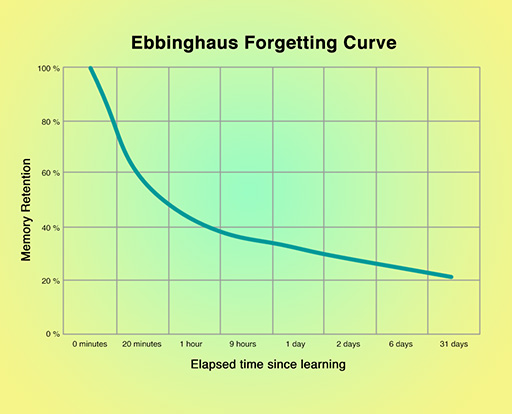
Cognitive science demonstrates that memory and understanding are dynamic. The work of
Hermann
Ebbinghaus on memory decay illustrates that retention changes over time. Later
research in retrieval practice and spaced learning, advanced by scholars such as Robert
Bjork, emphasizes that learning strengthens through reinforcement and desirable
difficulty.
Learning:
- Develops through repeated interaction
- Strengthens with application
- Weakens without reinforcement
- Varies across contexts and cognitive load
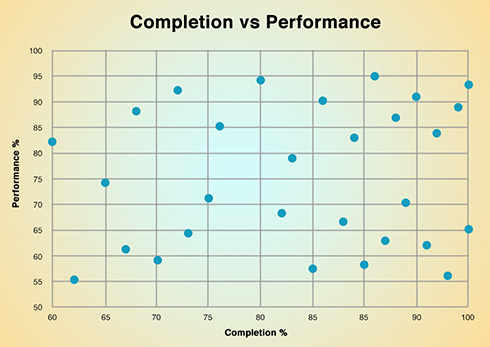
Performance in one condition does not guarantee performance in another. Competence is not
merely demonstrated — it is sustained, reinforced, and transferred.
Measurement systems must therefore evolve to reflect learning as an
ongoing,
context-sensitive process rather than a static achievement.
Why This Matters at Scale
In workforce development and institutional education, scale
introduces complexity.
Research in organizational capability and human capital development consistently highlights
that performance reliability depends not only on training completion, but on the stability
and transferability of knowledge in operational contexts.
Without deeper visibility:
- Training ROI remains difficult to evaluate beyond participation metrics
- Skill-readiness cannot be confidently inferred from certification alone
- Performance variability may only become apparent under real-world conditions
- Institutions operate reactively rather than proactively
As capability systems grow larger, uncertainty compounds Improved learning intelligence enables institutions to move from reporting activity to understanding capability. It supports strategic workforce planning, risk-aware training investments, and more resilient performance ecosystems.
Our Research Direction
At Edculcate, our research focuses on building scalable systems that
analyze large-scale learning interactions and translate them into structured
intelligence for institutional decision-making.
Our approach draws from:
- Behavioral data science
- Longitudinal learning research
- Applied cognitive psychology
- Scalable computational systems
Rather than relying solely on terminal assessment outcomes, our work explores how
interaction-level learning data can provide deeper visibility into capability formation over
time.
Our modeling architecture and analytical frameworks are proprietary and under active IP
development. As this research advances, our objective is to contribute meaningfully to the
evolving science of learning measurement at institutional scale.
Selected Research Foundations:
- Ebbinghaus, H. (1885). Memory: A Contribution to Experimental Psychology.
- Bjork, R. A. (1994). Memory and Metamemory Considerations in the Training of Human Beings.
- Biggs, J. (1996). Enhancing Teaching through Constructive Alignment.
- Research on spaced repetition, retrieval practice, and transfer of learning.